Solutions to the barriers faced by quadriplegics and the technology to make life easier.
Showing posts with label recreation. Show all posts
Monday, July 28, 2014
Ramps - Erindale Pond
Continuing the series on ramps, we will take a look at one of the urban ramps I have encountered multiple times. The one pictured above leads up from the Erindale pond in Saskatoon, Saskatchewan. The path around the pond is quality asphalt, reasonably level with only a few instances of lips where the building materials transition between concrete, paving stones or asphalt. The tricky part comes when you need to climb up from the shoreline to get back to your vehicle or where you came from.
Often a photo does not accurately represent the grade of a ramp and I fear that this photo is one of those, despite my best efforts. This ramp is reasonably steep for an urban setting but it is very long and without any level portions where a rest might be appropriate. Other techniques, such as allowing a wheel to back into the landscape tie at the side of the ramp, can work when a rest is needed, however, often there are no options like this and the only alternative is to turn your wheelchair sideways to lessen the effort needed to prevent rolling back down the ramp. The biggest problem with this sideways parking technique is the energy it takes to get straightened out and resume climbing.
I mention that this ramp is a reasonable grade for an urban setting. Far too often when new strip malls or other buildings have their parking lots paved the grade of the slope leading to either a concrete curb cut or the ramp leading into the building is ridiculously steep. For whatever reason, our home builder told us that they legally could not build my ramp in the garage because it would be a grade of 1:10, 1:12 being legal for a public building. This was our own private dwelling. The number of parking lots I see with ridiculously steep slopes before you actually reach the curb cut, sidewalk, or ramp to the building's front door are ridiculous. Situations like this display thoughtless guideline compliance without any common sense.
Thankfully, regardless of a slope's grade, devices such as hill climber brakes exist and can be used to grab your wheels so you cannot roll backwards. Those will be examined in the future.
We are thankful that these ramps exist, as opposed to simply being stairs, but improper implementation makes them less effective in building a barrier free community.
Source: Urban settings and do not be afraid to contact your city counselor if there are blatant problems with a local ramp, be it the condition of the building materials, the grade or transitions from level ground to the ramp or the ramp to the surface at the top.
Monday, June 30, 2014
Ramps - Our Deck
The time has come to begin my series on elevated access. By that I mean ramps and lifts that enable us to access those places not on ground level. I say that the time has come because until now I have focused on subjects whose consequences have the greatest impact upon quadriplegics. Ramps and lifts affect such a broad range of disabilities it would be difficult to list them all.
This ramp is the one in our backyard that allows me access down to our patio, flower boxes and lawn. Our deck supports are made of treated lumber but the surface materials are made from Trex composite material that does not require staining or care of any kind. That, combined with the aluminum railings, was undoubtedly more costly initially but over the life of the deck the savings in stain and labor to maintain it will easily pay for the additional cost. At some point I will discuss the invisible costs of living with a disability. Paying for labor to do something as simple as stain a deck is one example of those less visible costs.
Though it does not look very steep because of my choice of ultra-wide-angle lens, the ramp is the building code standard of 1:12, which I find a very easy climb, unless my push rims happen to be wet from watering flowers or chasing the dog with the hose. Times like those I am grateful for my hill-climbers which, when engaged, prevent me from rolling backwards. On occasion the flat landing halfway up the ramp has been a great benefit to either have a different view of our backyard or to be a place to turn around and chase the dog back down.
One final note for anyone looking to build or modify a home to be barrier free: Be aware of your space limitations on each side of the house. On one side we have crushed rock, which I cannot access nor cross. On the other side, by the patio as pictured above, is a sidewalk that leads to her front gate with the inconvenient exception that the air conditioner blocks my path. Had we known, or had our home builder being more mindful of the situation, we would have either relocated the air conditioner or had it installed higher up so that getting past my wheelchair, or with the lawnmower, would be possible.
Source: Custom-built by our home builder to suit the size we wanted and the space available.
Labels:
aluminum,
composite,
custom made,
evening,
hdr,
landing,
lights,
mobility,
outside,
quadriplegia,
railing,
ramp,
recreation,
rope,
tetraplegia,
trex
Monday, April 7, 2014
Sport Cuff
I misplaced my sport cuff many years ago because I always just use a new pair of The Gloves with strong new Velcro as my tool of choice to hold on to any sporting device with a straight handle. When I wear The Gloves I do not diminish my ability to wheel nearly as much as when I tried using the above pictured sport cuff. I also found the sport cuff to limit my wrist function which is so essential to so many sports, especially those such as badminton or icefishing where wrist movement is really essential to the technique. However, for someone who's muscles that control the wrist are paralyzed this cuff makes some sport possible where it would not have been, otherwise.
For sports such as tennis or fishing with a large rod, where the movement involves more control by the larger arm muscle groups, a sport cuff has great advantages. This one was borrowed from my friend, and former model, Paul. Though he and I have virtually the same level of function, there are a few muscles of mine that provide me just a little more function than him. Where every little bit of function counts, especially where wrist flexion and triceps come in, a sport cuff like this can mean the difference between being able to successfully participate in an activity or not being able to.
Source: Occupational therapy product catalogues, online, or custom made.
Monday, March 31, 2014
Velcro
Without Velcro The Gloves could not be tightened enough to provide me the dexterity that they do and many of the tasks I am able to complete successfully, would either be much more difficult, or simply impossible to complete. Getting a grip on certain exercise equipment, to help with Strengthening our functioning muscles, is made easier with Velcro. It enables the design simplicity of a Universal Cuff and Razor Cuff, an alternative to the difficulty of tying Shoelaces and so many other daily applications where a tight, but adjustable, fit is needed to be possible with limited dexterity.
By no means is this list exhaustive. In many cases Velcro can be creatively added to an existing device, article of clothing or tool to make it friendlier for us to use. Many stores now carry cinch straps made entirely out of Velcro. These are useful for places that something such as a rubber band or a bungee strap is just too difficult for us to use. If you have a great example of Velcro use let me hear from you.
Source: Department stores, dollar stores, hardware stores and sewing stores.
Monday, January 20, 2014
Winter
Until now I have focused on the positive. Solutions and helpful technology. The barriers exist, be they man-made or natural and unavoidable.
I used to enjoy icefishing, hockey, tobogganing and a lot of other sports that take place only in winter. But, that has all changed since my injury. I still enjoy icefishing, when the amount of snow on the ice, more likely depth of the ruts to get on the ice, is scarce enough that the minimal clearance of my lowered floor minivan can navigate without getting hung up or damaged. It has been a number of years since I have been able to get on the ice and I do really miss it.
However, that sickly photo above that encapsulates my view of winter is the utter truth. Last winter was brutal. This one is starting off in the same way, having just emerged from a bitter three-week streak of regular -30°C or lower nighttime lows with both snow and wind. The cold makes it dangerous for anybody, especially someone with reduced circulation and who cannot feel their legs freezing. But, when you can get where you are going is not such a big issue. When someone like our neighbors two blocks away don't shovel their snow all winter, and you have over 60 cm of packed snow on a public sidewalk, it makes it dangerous and almost unusable for anyone. They have refused to shovel the sidewalk again, this year. You chose to buy a corner lot. Shovel your snow!
I try to restrict my excursions to essential outings when it is that cold and I tried to arrange to have someone with me, just in case. If I get stuck it would not take long for my hands, protected only by the gloves, to begin to freeze before someone came along to give me a push. The cold is hard enough on all vehicles but the adaptations to my van are already something to respect as fragile. The kneeling of my van and the ramp have performed flawlessly even in the coldest weather but, when possible, I turn off the kneeling and park side a curb or accept the push to reduce the moving parts and hopefully save something breaking.
Finally, if I have to choose winter weather, I will choose no snow and colder than -15°C. Why? Because ice melt substances do not work below -15°C. When they do melt it clings to my tires and push rims, making them wet, slippery and gritty, not to mention the mess they cause me to track in. I am also aware of the potential toxicity to pets some of them have. When it is nice and cold everything is as solid as concrete and much easier to traverse by wheelchair if the snow is hard packed or properly cleared. Living in Saskatoon has taught me not to hope for the later.
I have considered starting up a site to shame cities for their disgraceful inaccessibility but I fear that it would be focusing too much of my energy on the negative, instead of the positive. As well, peers of mine who have lobbied for years spent much of their energy and put much of their heart into what resulted as miniscule improvements and the civic government of the time patting themselves on the back like they had moved mountains.
Solutions: Choose outdoor activity for less cold days, when possible. Plan activities, hobbies or projects for the worst of the winter months. And, unfortunately, complain when neighbours, cities and businesses do not make reasonable attempts at their legal and moral duty to clear snow.
Monday, January 13, 2014
Card Holder
Card season is upon us more than ever. That first snowfall outside, as seen in the photo above, happened way too early this year and last year but there is little a person can do except to find favorite ways to be entertained indoors. Any game with cards is a popular one.
There are commercially made cardholders available on the market but I have found that many of them require as much dexterity as holding cards does. Such things as spring-loaded clips or awkward angles where cards sit in fan-shaped slots, both of which are no easier than simply holding the cards with paralyzed fingers.
The cardholder you see on the table was the result of my dad seeing his son struggle with the cards, telling everyone to "hold on, a minute," finding a scrap of lumber, cranking the tablesaw blade to a 45°, running a cut half-deep through it and then slicing the scrap of lumber into two equal pieces. The result was two identical cardholders that I use for any game that requires holding more than about four cards. This cardholder is long enough for at least 13 cards. Occasionally, for games that use nonstandard decks of cards, I wouldn't mind if it were a little bit longer. Usually in those cases cards can be grouped together, though. Length is something to consider if you are having one made for yourself.
Having it sitting on the table allows me to use two hands to pick up and arrange cards and it is easily tipped on its face to conceal my hand, should I need to leave the table for a minute.
This is not a tool exclusive to a quadriplegic. A person with carpal tunnel syndrome, arthritis, tremors or any other condition affecting dexterity would benefit from something like this and be able to maintain a fluid pace of gameplay.
Source: Custom made. Commercially made devices available at some medical supply stores, through an occupational therapist or online.
Labels:
29 point hand,
cards,
crib,
cribbage,
custom made,
dexterity,
fingers,
lumber,
quadriplegia,
recreation,
social,
tetraplegia,
wood
Monday, November 25, 2013
Push Rims
With it being the season of snow accumulation, wet tires and push rims, and the friction reduction caused by the cold, this post is very intentionally timed for now.
There are the less frequent mobility enhancers such as the recently mentioned Lever Door Knobs and Automatic Door Openers but, for every push of the wheels with paralyzed hands, coated hand rims make all the difference. Losing your grip part way through a push wastes energy, can cause a loss of balance and, if it happens on a slope, can make you need to stop, straighten out, and restart your climb.
When first establishing my preferred choices of traction enhancement The Gloves were an obvious option given to me. However, the first pair I tried that had only leather palms were not enough to give me efficient pushes on uncoated rims. It was standard procedure for the rehab department to provide plastic coated hand rims for people in my situation but, at the time, they did not have a a set that would fit on the chair I was in. I made due. After being approached by a variety of wheelchair salespersons, making the reality of my situation more concrete, I was given a few different makes and models of chair to try. Many of those did not come with coated hand rims and additional traction was added in the form of surgical tubing wrapped around the bare aluminum push rims. It helped but for the most part it just rolled on the rims.
Once I discovered the gloves with the patch of rubber sewn to the palms, in combination with plastic coated hand rims, I did a lot better. That is, until they got wet. It seemed that no amount of force or effort would give me a good push when those rims had any water or snow on them. That went for braking, as well. Some of the injuries to my fingers that occurred because I had no breaking make me cringe at remembering them.
It is only within the last few years that newer products have come on the market. Typically they are third-party push rims made from varieties of material such as plastic mixed with neoprene or other rubbers. Black Sparkles are the type pictured above and seem to provide a respectable mix between durability and additional traction. However, they are becoming very hard to find and for quite some time the precision in which the tabs that bolt to the actual wheel rim was sloppy and you were simply lucky to get a set that would fit your rims properly.
I tried two sets of Push Blax which provided excellent grip when dry and reasonable grip when they were wet. Unfortunately, the durability of these was abysmal and when I was using them there were black crumbs of rubber absolutely everywhere. On the dash of my van, in my shoes, on my desk, simply everywhere. My second set wore out one week before our trip to Vancouver and Seattle, the cities with the most hills that I have ever been to, where I needed traction and braking more than I ever have before.
My current set are Q Grip and are holding up beautifully, almost as durable as standard plastic push rims with nearly as much grip as the Push Blax. I have yet to test them through a winter but from the rain I have been in I suspect they will perform nicely.
Rim coatings will get dinged up from running into things and worn down from braking but your chair shouldn't need to be in the shop for an extra day more often than it already needs to. And in the time between maintenance you should be able to get where you are going based on your strength, not on the deficiencies of paralyzed hands.
Source: Wheelchair dealers and mobility stores.
Monday, September 2, 2013
Strengthening
Exercise is important for everyone but even more so for we quadriplegics. Keeping our arms and shoulders strong as long as we can, to maximize and prolong our independence, is not just for our physical health but our mental health, as well. The question is, outside of rehabilitation centers, when was the last time you saw a fully wheelchair accessible gym? That is, with cuffs and quadriplegic-friendly handles on the weight machines, not just machines that can be wheeled up to.
Downstairs, collecting dust, is a weighted pulley system with the adjustability (much of which I cannot adjust independently) to perform a small variety of motions to work different muscles and muscle groups. It is not too large and cumbersome but enough so that it does not have a dedicated place in our home to be mounted to the wall. There are a few locations that it could be placed but they are tucked away in most uninviting and unmotivating locations. Therein lies one of the largest obstacles to regular exercise for many individuals, disabled or not, which includes myself. Lack of motivation.
A good friend and I make regular visits to one of the city's indoor facilities which, after a lengthy process of cutting through red tape and persistence in communicating with the right individuals, has a fully accessible workout machine. Unfortunately, it's is in a cramped room with a number of other workout machines used by many individuals who do not understand the importance of not blocking the accessible machine with cooldown mats, chairs and other clutter that prevent us from using it. Add to that the missing handles, pins or other disrepair and what could be a very effective machine has become more of a hassle than a help.
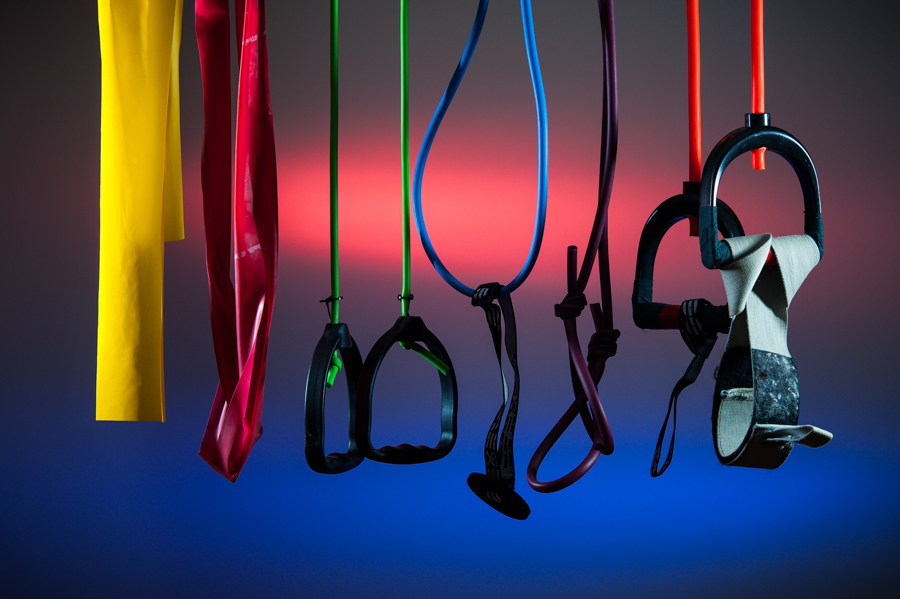
As a result you will find us most mornings wheeling on the track and allocating time to use the therabands in the picture above. Those therabands are lightweight, easy to transport, made to fit our needs and can be used anywhere. It is in front of a TV or near a stereo that I find it easier to grab the therabands and work with them while watching or listening to something, rather than tucked away by myself in the basement where the weights and pulleys would be.
From left to right you have theraband ribbons and theraband tubing, increasing in resistance from left to right. This particular ribbon is latex, unfortunately. The endless white powder that comes off of them is a significant irritant, even an allergy, to a lot of people. I am unaware of non-latex theraband ribbon, which is unfortunate because ribbon is much easier to carry than the tubing. The handles accompanying the green theraband tubing are nicely adjustable to allow any length between them which makes them suitable for the widest variety of exercises. The disc and strap attachment on the slightly stronger blue tubing is designed to be slid behind a door before closing it to provide an anchor point for the tubing. This provides a solid, adjustable, place to pull from without the fear of damaging a lever door handle or other makeshift anchor point. We often slide this between the wooden slats of the benches surrounding the track where we wheel.
Simple loops tied in the end of the purple theraband tubing allow a place to grasp, or wrap around the wrist, to get the right length for various exercises. My strongest theraband tubing came with handles that had a red plastic tube that rolled as you used it. For someone who cannot grasp the rolling part it was a 50 pound slingshot waiting to hit someone when it fired out of my hand. Consequently it was secured with hockey tape and had other wrist straps added to the handles to give a secure place from which to pull. The gray strap was originally one that I had used to secure my legs together and assist in getting them pulled onto the bed when I was still rebuilding my strength, post injury. As with my razor cuff, it was made by an amazing fabricator that worked at the rehab facility I was at. Thank you, again, Beulah.
In addition to the therabands, sitting next to my computer are dumbbells that incorporate Velcro straps. Unfortunately they only go up to 5 pounds and are difficult to double up on one hand or arm comfortably. Even at 5 pounds they often cut into a person's hand when being used. That may be why they are only available with Velcro up to that weight. I imagine if I thought about it and work with some paracord I could come up with a helpful handle for the 15 pound dumbbell in the back, but the fear of dropping it and damaging the floor or hurting myself is greater than the payoff. Thankfully the therabands can very easily be doubled up or stacked to add as little or as much additional resistance as you would like as your strength grows.
Not pictured are the pair of 1.5 pound wrist weights that can be Velcroed on to either the dumbbell or a person's wrist to add that little bit of extra weight. Unfortunately, with our arms being as skinny as they are and no longer tapered, typically the wrist weights slide up and down the arm as you raise and lower it to perform the exercise. Currently one of them is employed as a counterweight for the opposite end of my boom arm used in making many of the photos you see on this site.
Source: Dumbbells - Department and sporting goods stores.
Therabands - Occupational and physiotherapists and online retailers. Bodylastics is where we got our last batch from.
Labels:
beulah,
commercially available,
custom made,
dumbbell,
exercise,
health,
latex,
non-silicone,
paracord,
quadriplegia,
recreation,
resistance,
rubber,
strengthening,
tetraplegia,
theraband,
velcro
Monday, August 26, 2013
Wheelchair Cushion
The ability to feel your body is significant and should not be taken for granted. The ability to move your body is even more vital. When you cannot feel it and cannot move it, technologies like specialized wheelchair cushions can assist in the prevention of pressure sores and aid in maintaining proper posture and balance. Cushions have a role much more than just pressure relief.
There are cushions made out of dozens of little air pockets that can be pumped up or deflated as necessary to get the most comfortable fit. There are cushions made out of multiple layers of different densities of foam and combined with a gel top layer. And there are types made out of synthetic materials formed into a breathable, lightweight honeycomb shape like the cushion in the photo above. This is not an exhaustive list of the different types of cushions but what I would consider the three most common.
They can be simply a flat rectangular design, extra thin for sport purposes, and contoured like the one above to improve posture and balance. A cushion with a contour like this can be used on a standard wheelchair seat to simulate a newer design of wheelchair frame that incorporates ergonomic seating. That is one whose frame keeps your hips perpendicular to the ground. The standard wheelchair frame tips your whole body back a few degrees to bring your knees up to your chest slightly, improving your balance. This will be covered in a future article.
The best way to find the cushion that's right for you is to try many different kinds, see which minimizes pressure while still providing good balance, which helps with maneuverability and independence in your chair. When you find the happy medium between comfort and balance you will begin to trust that you are not going to fall out of your chair. That's when you will feel confident in trying things, such as wheelies, that will get you over obstacles you were not able to overcome before.
Source: Wheelchair dealers and many medical supply stores. For insurance purposes, an occupational therapist's approval may be required.
Monday, August 5, 2013
Spray Bottle
When most people hear paralyzed or quadriplegic they immediately think of the lost ability to walk, to the point that the narrow sightedness of its portrayal in media is saddening. Phrases such as "wheelchair-bound" or "confined to a wheelchair, just dreaming of the day they can walk again" are very frustrating to someone living with a disability where walking is but a very minor portion of the inconvenience of said disability. Not to mention that most of us do not sit around doing nothing but dreaming of when we can walk again and "resume" our lives. But, I digress.
What the media and educators fail to mention are the things more important to well being, like the inability to sweat when overheated. The increased sensitivity to temperature changes and decreased ability to regulate our own body temperature makes we quadriplegics more susceptible to temperature related discomfort and ailments.
Clothing can be added in cold temperatures to help stay warm but once we get overheated, even in shade, it can be difficult to cool back down. It's not the same as heat being removed from your body the way sweat brings it to the surface but a spray bottle or a wetted cloth or shirt can help to alleviate the overheating from a warm summer day or vigorous exercise.
With our current patio set I am unable to raise and lower the umbrella and, most of the time, that is fine with me because I typically like full sunshine. But there are the times when I appreciate having my spray bottle to allow me to stay outside longer and enjoy as much of the short Saskatchewan summers as I can.
Source: Any department store or dollar store.
Labels:
commercially available,
health,
heat,
outside,
recreation,
summer,
sun,
sweat,
umbrella,
water
Monday, July 15, 2013
Universal Cuff
This is a standard universal cuff designed to Velcro around the hand. The pocket provided on a standard universal cuff is typically the right size for something like a piece of cutlery, toothbrush or other similar sized tool or utensil. Ironically, our standard cutlery was too large for this cuff. A prime example of how these cuffs can be very application-specific. As mentioned previously, I had a larger version that I used for my razor. I have also seen versions large enough for a modified ping-pong paddle or just about anything else with a handle of a smaller size. Some of the premade universal cuffs have a pocket, or even just a sleeve instead of a complete pocket, made out of an elasticized material so that they can accommodate a wider variety of utensils or tools. What I have found with these is that unless the tool is really big the elasticized sleeve does not provide enough tension to properly hold utensil, which results in it falling out or sliding all the way through so that the tines of a fork, for example, are right up against your hand. Once you get larger than a standard smaller size, say a pool cue, fishing rod, tennis or badminton racquet, there is a larger version that falls outside a standard universal cuff that will be shown in a future post.
As this cuff is shown it may be considered upside down by a lot of users of universal cuffs. Typically the utensil would be positioned the other way, with the pocket side of the cuff against the palm of the hand. For me, I found that it added additional helpful tension to use a universal cuff upside down. This way when pulling my wrist back into extension the raising of my tendons on the back of my hand would add tension, making the utensil less likely to slide out of the pocket. Something could be added to the utensil for additional grip to make it less likely to slide out of the pocket, but that means not just having a universal cuff but specialized cutlery to use with. It is a small additional price to pay for independence but it is one more adaptation to consider and possibly eliminate when the time is right.
I no longer use universal cuffs for anything. As mentioned in the Plasti-Dip and Typing Pencil article, I type with a pencil woven under my index finger, over my middle finger and under my ring and pinky finger, with the eraser side coming out the bottom of my hand, which is what I type with. For eating I rest the fork on my thumb with the end of the handle between my middle and ring finger. For anything involving cutting I place the knife between my palm and my glove with the handle of the knife protruding between my middle and index finger, as will be demonstrated in next week's post regarding knives.
Source: These are available in occupational therapy catalogues, but since each application can be so specific, they are typically custom made by an OT or aide.
Labels:
commercially available,
cooking,
custom made,
d-ring,
eating,
fork,
health,
living,
pocket,
quadriplegia,
recreation,
sleeve,
spoon,
strap,
tetraplegia,
toothbrush,
universal cuff,
utensil,
velcro,
webbing
Wednesday, May 1, 2013
The Gloves
One of the most significant moment to moment challenges of being a quadriplegic is the lack of hand and finger function. Being able to firmly grasp things with one hand, use tools and grip surfaces is not something to be taken for granted.
These rubber-palmed, leather, quad wheelchair gloves (quad because of their lack of fingers and wrap around style of donning) provide protection from the disproportionate amount of use our hands go through on a daily basis. They are, for me, shoes, brakes, warmth, a means to hold on to tools and utensils, a source of rigidity for my fingers, friction for countless applications and an item that spends more time on my body than off of it. This well-used pair is very near retirement.
Many of my peers use football receiver gloves or weightlifting gloves, both of which have full fingers and can be time consuming to get on curled, stiff digits. For me, these gloves provide a shape to my thumb and index finger which was, and now is, essential to my wrist tenodesis. Tenodesis will be a future post but, for now, let me explain it this way: When tendons tighten that tightening can be guided to be advantageous. As my newly paralyzed thumb tendons tightened they were guided so that as I pull my wrist back into extension my thumb pinches against my index finger, providing some functionality.
The advantage of my quad gloves is the tight band the Velcro creates around my first knuckles. Sliding tools between the glove and my palm is the key to my ability to cook, build things at my workbench and many other tasks where this can effectively simulate a grip. Many posts to come will make this very clear.
They may not be ideal for a Saskatchewan winter, but I'd rather get where I'm going with cold hands than be comfortably warm and stuck in the snow.
Source: Hatch - They can be difficult to have shipped to Canada, but resellers are available and the gloves are available on Amazon.com.
Many of my peers use football receiver gloves or weightlifting gloves, both of which have full fingers and can be time consuming to get on curled, stiff digits. For me, these gloves provide a shape to my thumb and index finger which was, and now is, essential to my wrist tenodesis. Tenodesis will be a future post but, for now, let me explain it this way: When tendons tighten that tightening can be guided to be advantageous. As my newly paralyzed thumb tendons tightened they were guided so that as I pull my wrist back into extension my thumb pinches against my index finger, providing some functionality.
The advantage of my quad gloves is the tight band the Velcro creates around my first knuckles. Sliding tools between the glove and my palm is the key to my ability to cook, build things at my workbench and many other tasks where this can effectively simulate a grip. Many posts to come will make this very clear.
They may not be ideal for a Saskatchewan winter, but I'd rather get where I'm going with cold hands than be comfortably warm and stuck in the snow.
Source: Hatch - They can be difficult to have shipped to Canada, but resellers are available and the gloves are available on Amazon.com.
Subscribe to:
Posts (Atom)